 We meet Tobias Rylander, the designer behind Beyoncé’s world tours.


The stage is set
We meet Tobias Rylander, the designer behind Beyoncé’s world tours.
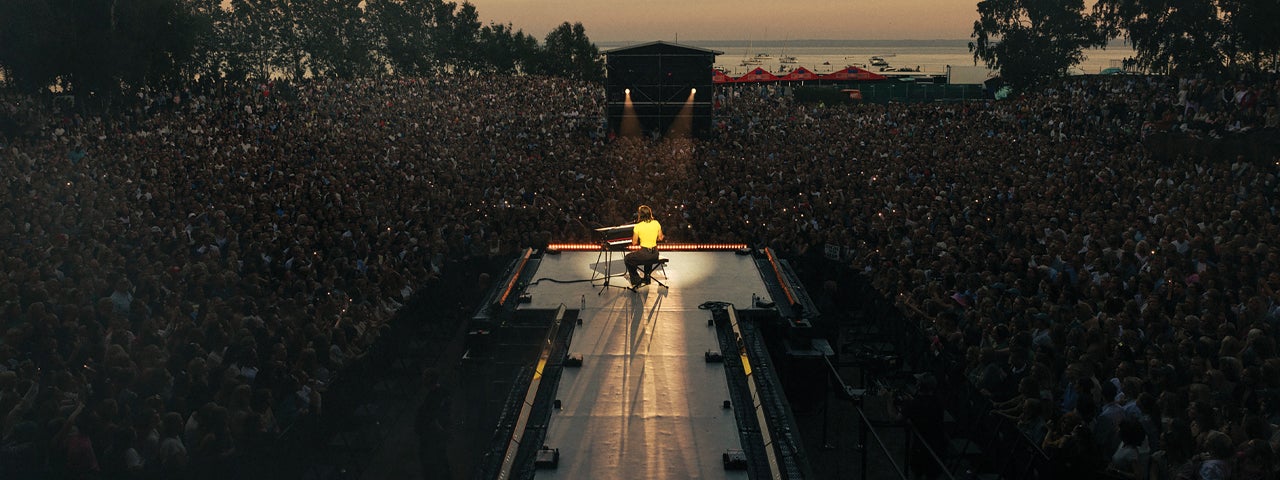
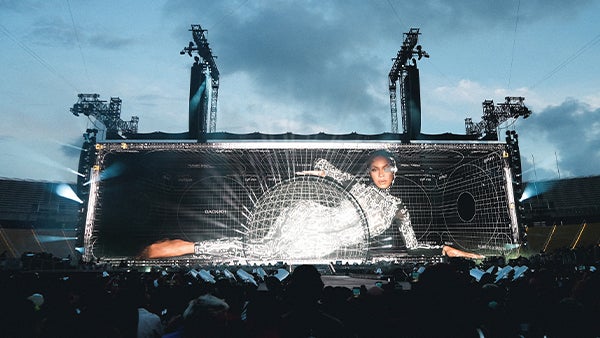
“The most powerful moment of a show might be just one candlelight on a piano,” says Tobias Rylander. It’s perhaps a surprising statement from someone who designed Beyoncé’s glitzy Renaissance and Cowboy Carter tours, The 1975’s screen-studded arena shows, and Chappell Roan’s neon-fuelled 2025 Grammy performance. But the Swedish lighting and set designer, who travels the world some 200 days a year to illuminate countless stages, is always thinking about intimacy.
Rylander is in Los Angeles when we speak, where he lived for a decade producing shows for the likes of FKA Twigs, Robyn, Steve Aoki and Acne Studios, before returning to Sweden during the pandemic. He’s in Hollywood to produce Childish Gambino’s show for Camp Flog Gnaw, the annual festival curated by Tyler, The Creator. “I designed [Gambino’s] world tour last year,” Rylander says, “but unfortunately, he had some health issues and postponed some shows, so this is his return to the stage. I love working with artists like him, who have a genuine purpose to their art, where everything has a reason and a conceptual idea. That’s when I do my best work.”
Despite dressing up as glam rock band KISS and putting on shows in his living room (complete with fake plywood guitars as props), becoming an award-winning stage designer wasn’t born from Rylander’s childhood dreams, but was instead more of a coincidence. “I was really bad in school,” he admits of his formative years in Leksand, a rural area of central Sweden. He tried to study classical trumpet at college, but as much as he loved music, he soon got fed up with practising it. His solution? Drop out, move to Stockholm, couch surf with his friends and hang out at local music venues.
“I had a friend who was a sound engineer,” Rylander recalls, “so I started hanging out at his venue – and next to him was a lighting console that no one was touching. I started playing with it, and I really fell in love with it. I believe that everyone has their thing in life, but very few people actually stumble across it.” He likens his discovery to a folktale of a man who once hit a rock out of frustration but quickly realised that his life calling was in stone masonry.
In the 25-plus years since that epiphany, Rylander has taught himself everything from CAD drawing and 3D rendering to highbrow concepts of light and world-building. He has become in demand beyond the world of music, with Balenciaga, Apple and Riot Games all hiring him for their major events. But his growing skillset is acutely focused on one objective, no matter the project: “It’s all about what we're trying to communicate and how we want people to feel when they see it.”
For Childish Gambino’s show, which is based on his 2024 album, Bando Stone And The New World, Rylander was tasked with creating and presenting the dystopian New World. The set-up is striking: projections across hazy smoke, LED strips that drape from the roof and display light as if in motion, and – at Camp Flog Gnaw – a drone display mapped to the shape of a heart as the artist revealed news of his recent stroke to the audience.
Challenges like this, as Rylander puts it, encourage him to embrace a narrative and design shows with deeper intent. He’s seeing this format unfold across the music industry more frequently lately – an evolution he’s grateful for: “It’s not just stage lighting and eye candy any more; everyone’s actually putting in the effort to tell a story.”
One could build a narrative onstage by using towering screens with expository video footage. But where’s the spectacle in that? A signature Rylander technique, which appears in the Gambino show, is using light as video and vice versa. He developed this method while on tour with The xx and The 1975, in what he calls a complete accident.
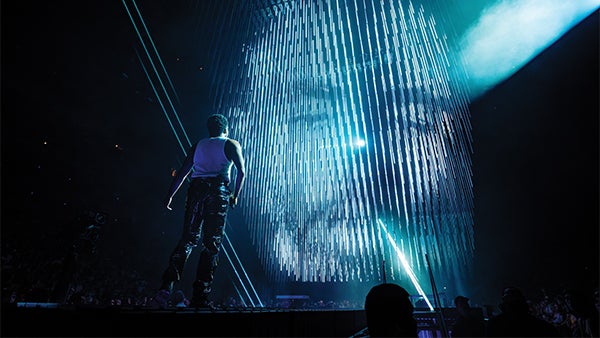
“I was doing the Coexist Tour for The xx, where I designed this big three-dimensional glass X that was filled with smoke, and I projected onto that smoke,” he says. “It looked cool, and it was something that hadn’t been done before and everyone can see it on film – the volumetric lighting beams come out of the lens on a video projector. I sat, night after night, just looking at those organic movements of light, and I thought, ‘That’s the most beautiful light that I’ve ever seen.’ That’s when I started to use projection as lighting. When I started to work with LED screens, I realised that every pixel is lighting information.”
Following this realisation, Rylander began experimenting with LED screens, implementing them into shows and using them like an art installation. He cites Nine Inch Nails’ Lights In The Sky Tour and a 1998 Black Rebel Motorcycle Club live show using white backlight, silhouettes and tons of smoke as some early influences. Today, he looks to libraries, museums and architecture for inspiration and remains dubious of algorithmically curated trends. “Pinterest is amazing, and everything looks really beautiful, but it’s lazy,” he says.
He calls this phenomenon creative inflation – where artists and their creative teams present ideas found on social media feeds. “They will come with a mood board or a keynote presentation, and they all look the same,” he says. “I really try not to go to Pinterest, Google or Instagram to find inspiration because I know anything I find there, another 1,000 creators will have seen the same thing. It’s quite dangerous. Sometimes, I’m shown pictures of my own work as a reference and they don’t even know it’s mine.”
“It has been really interesting,” he says with a chuckle. “Without bragging, me and Matthew [Healy], with The 1975, have always been one step ahead – much thanks to him; he’s always pushing me and asking me to do some very uncomfortable things. When he asked me to design a theatre set and put a house [onstage], it was very uncomfortable. Once we did that successfully, half a year later, everyone in the music industry is putting a house on the stage.”
With so much creative inflation, one could fairly surmise it’s tough to know when a show is making an authentic impact on culture. But Rylander points to the first curtain drop of The 1975’s Still At Their Very Best Tour as one of the most meaningful experiences of his career.
“Me and Jamie, their manager, were just standing there at front of house, so nervous because we had no idea how the audience was going to react. And then the curtain dropped, and we knew it was an immediate success. They absolutely loved it, and it just made complete sense.”
A more unusual barometer for success, by Rylander’s metrics, is whether his work is identifiable by a thumbnail. As fans search online for footage of a show, he believes his job is done when they can tell which artist and which tour the video is from. The 1975’s act, he says, has developed such a strong visual identity that fans can even tell which song is in a video based on the lighting and set design, whether it’s a sold-out stadium or a more humble venue.
“When it’s scalable from an arena show to a club show, and you can keep that visual identity – when it’s recognisable by thumbnail and campaign – then I’ve done a great job,” he says. It’s one of many challenges that Rylander executes with apparent ease. Whether it’s a candlelight on a piano or a dazzling high-tech display, the client’s request is, ironically, always the same. He laughs: “Usually the ask is: ‘We want something never seen before – but it also needs to pack down into a suitcase and fly’.”
Banner Image Credit: Robin Boee Visuals